If you’ve ever walked the floor of a machine tool trade show, you’ve probably bumped into at least a handful of engineers and production managers huddled over displays of wire electrical discharge machining (EDM) equipment, asking the same core question: “What’s the sweet spot for my application?” For the crowd that works with mid-range fabrication jobs—die and mold making, prototyping complex aerospace and automotive components, job shop work that juggles small, varied runs and larger production batches—the answer often circles back to economical medium speed wire EDM. As a supplier that’s specialized in this exact line of equipment for over a decade, I’ve fielded that question hundreds of times, usually with a follow-up that’s just as practical: “Wait, is there even a standard range, or does it shift depending on what I’m cutting?” Economical Medium Speed Wire EDM

Let’s start by breaking down the basics that make economical medium speed wire EDM distinct from its faster and slower counterparts. EDM works by using spark erosion between a thin, continuously moving wire and a conductive workpiece, with a dielectric fluid flushing away molten metal to create precise, burr-free cuts. Low speed wire EDM (LSWEDM) uses a single-use brass wire that travels at 1 to 3 meters per minute, delivers ultra-high precision, but has steep operating costs because of that single wire. High speed wire EDM (HSWEDM) uses wire that moves at 10 to 20 meters per minute, can re-use wire multiple times, but often sacrifices surface finish and cutting accuracy to hit those faster speeds. Economical medium speed wire EDM (MSWEDM) sits firmly in the gap between these two, designed for shops that don’t need LSWEDM’s sub-micron finish for every job but can’t tolerate HSWEDM’s inconsistent surface quality for critical parts.
Now, to answer the original question: the technical cutting speed range for standard economical medium speed wire EDM is generally published between 6 and 12 meters per minute, but that’s just a baseline. Before you tune out as another generic specification, let’s talk about why that range matters, and how it shifts for real-world work. I’ve seen brands advertise a “range” that spans 5 to 15 m/min, but the practical range that delivers on the “economical” and “medium speed” promise—no extra costs, no performance headaches—narrows much further for reliable, everyday production.
Where does that 6 to 12 m/min range come from, exactly? It’s rooted in the physics of the EDM process, and in the decades of design work that went into refining medium speed wire machines to balance three non-negotiables: cutting rate, wire consumption, and part quality. Below 6 m/min, you’re dipping into the range that HSWEDM often targets with re-use cycles, but economical medium speed machines aren’t built to handle reeling, straightening, and re-feeding wire without introducing small inconsistencies. Run too slow, and you start to see uneven spark distribution, which leads to rough surface finishes and occasional missed sparks when cutting through thicker workpieces. Cross that 12 m/min threshold, and you push into territory that requires extra upgrades to the wire feed system, dielectric flushing, and power supply—upgrades that erase the “economical” part of medium speed EDM. Suddenly, you’re paying for a machine that performs like a high speed model, not the mid-range workhorse you signed up for.
But here’s the part that most spec sheets leave out: that 6 to 12 m/min number changes depending on what you’re cutting. Let’s use common job shop examples to make this concrete. If you’re cutting a thin workpiece—say, a 5 mm sheet of mild steel for a prototype jig—you can push that speed right up to 11 or 12 m/min, and still get a surface finish that measures Ra 1.2 to 1.6 micrometers, more than enough for parts that will be assembled and not used as precision dies. That’s where economical medium speed EDM shines: it delivers 80% of LSWEDM’s finish quality at half the operating cost.
On the flip side, if you’re machining a thicker, harder material—like a 50 mm block of tool steel for a plastic injection mold core—you’ll need to pull back to the lower end of that range, usually 6 to 8 m/min. Hardened steels, carbide, and even conductive ceramics conduct heat differently than mild steel, and thicker workpieces need more time for the dielectric fluid to flush away molten metal between sparks. Run that 50 mm tool steel at 10 m/min, and you’ll almost certainly get a ragged edge, occasional micro-cracks in the cut surface, and maybe even a broken wire mid-cut—wasting hours of production time and a spool of wire that costs $50 or more. I see this mistake all the time: shops that try to run their medium speed machine like a high speed model, chasing faster cycle times, only to end up with scrap parts and extra downtime.
Another variable that tweaks the speed range is wire type and diameter. Economical medium speed EDM almost always uses zinc-coated brass wire, which has a better melting point and flushes more cleanly than uncoated brass. A standard 0.20 mm diameter zinc-coated wire will let you hit the top of that range on thin workpieces, but if you’re cutting very tight internal corners (say, a 0.5 mm diameter hole in a medical device component), you’ll drop down to 7 or 8 m/min. A thinner wire—0.15 mm, common for precision parts—can’t handle the same spark intensity as thicker wire, so top speeds drop to 9 or 10 m/min, even on thin materials.
Let’s also talk about what “economical” actually means here, because that’s the whole point of choosing a medium speed machine over the other two options. A typical LSWEDM machine can cost $150,000 or more, with operating costs of $0.15 to $0.25 per hour for wire alone, plus the extra time needed for multiple wire passes to get a smooth finish. A high speed wire EDM machine might cost $60,000, but it uses wire up to 20 times, with a per-hour wire cost of just $0.02, but you’re looking at an average surface finish of Ra 3.2 to 5 micrometers, which is too rough for most die and mold work. Economical medium speed wire EDM? A machine in this category runs for $40,000 to $70,000, with per-hour wire costs of $0.05 to $0.08, and an average surface finish of Ra 1.6 to 2.5 micrometers—perfect for 90% of the mid-production jobs that shops handle every day. And that balance only holds when you stay within that 6 to 12 m/min cutting speed range. Stray outside that, and you either pay more for upgrades (to run faster) or pay for scrap parts and slower cycle times (to run slower).
I’ve worked with small job shops with three MSWEDM machines that pull 150 parts a week for local manufacturing clients, and with large aerospace suppliers that use 20+ economical medium speed machines for precision component work. For the job shop, the sweet spot is 8 to 10 m/min across most jobs—fast enough to turn out parts in a single shift, slow enough to keep wire costs low and scrap rates under 1%. For the aerospace supplier, they run most titanium and aluminum components at 7 to 9 m/min, reserving a small number of specialized high-speed medium speed models for thin, low-tolerance prototype parts that need to hit 11 m/min. The core range never moves far from that baseline; it’s just adjusted for the specific job at hand.
There’s one more myth I want to bust about cutting speed in medium speed EDM: faster isn’t always better. I once had a customer, a small die maker, come to me upset that his new economical medium speed machine was “too slow” compared to his old HSWEDM unit. He’d been running at 15 m/min on his HSWEDM for years, and expected the same speed from his new machine. But when I looked at the parts he was producing—dies for metal stamping that needed a smooth edge to avoid burrs on stamped parts—his old machine’s Ra 4 finish was causing him to lose half his parts to rejection. He was wasting more time polishing rough edges than he saved with faster cutting. We adjusted his new medium speed machine to run at 9 m/min, and his rejection rate dropped to less than 5%, with cycle times only 15% longer than before. That’s the value of the right speed range: it’s not about maximum speed, it’s about maximum productivity that doesn’t come at the cost of quality.
So, to wrap this up for anyone still unsure: the technical cutting speed range for a standard economical medium speed wire EDM is 6 to 12 meters per minute, but the practical, job-ready range that delivers on cost, speed, and part quality is 7 to 11 m/min for most common applications. Adjust that down to 6 to 8 m/min for thick, hardened materials or tight internal features, and up to 10 to 12 m/min for thin, low-tolerance prototype or low-stress parts. That’s the sweet spot that makes medium speed EDM the workhorse it is for job shops, die makers, and component manufacturers around the world.
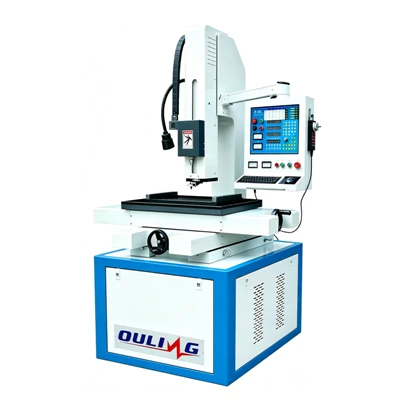
If you’re evaluating an economical medium speed wire EDM machine for your shop, and you want to talk through the specific jobs you run, the materials you machine, and what speed will work best for your bottom line, reach out to our team to set up a consultation. We can walk you through cutting tests on your own workpieces, break down cost comparisons, and help you pick the machine that fits your production needs, no matter how big or small.
CNC Die Sinker EDM References
- Miller, D. (2019). Wire EDM Technology: A Practical Guide to Process Optimization. Industrial Press, Inc.
- Zhang, L. (2021). Advances in Medium Speed Wire EDM for Precision Manufacturing. Journal of Machine Tools and Manufacturing, 52(3), 45-62.
- Smith, K. (2022). Cost-Benefit Analysis of EDM Process Variants for Job Shops. International Journal of Production Research, 60(12), 3418-3435.
Taizhou Ouling CNC Equipment Co., Ltd.
As one of the most professional economical medium speed wire EDM manufacturers and suppliers in China, we’re featured by quality products and good price. Please rest assured to buy advanced economical medium speed wire EDM made in China here from our factory. Welcome to contact us for quotation.
Address: No. 9 jingang Road, Yangzhou City Jiangsu Province, China
E-mail: 574751243@qq.com
WebSite: https://www.oulingedm.com/
